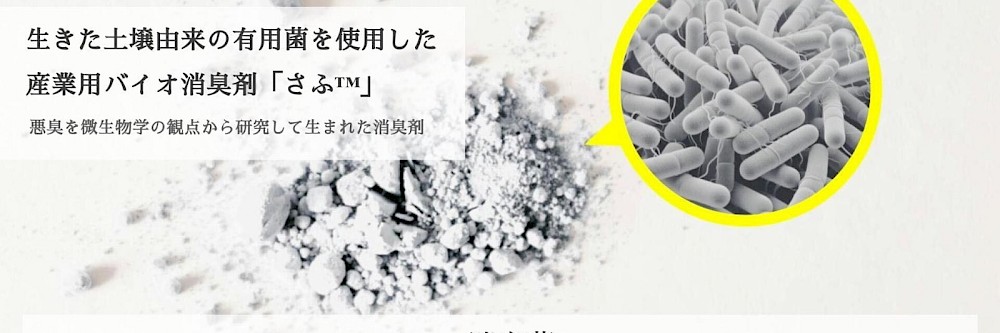
Industrial long-lasting deodoriser ‘Safu’ (English name: Bio_safu).
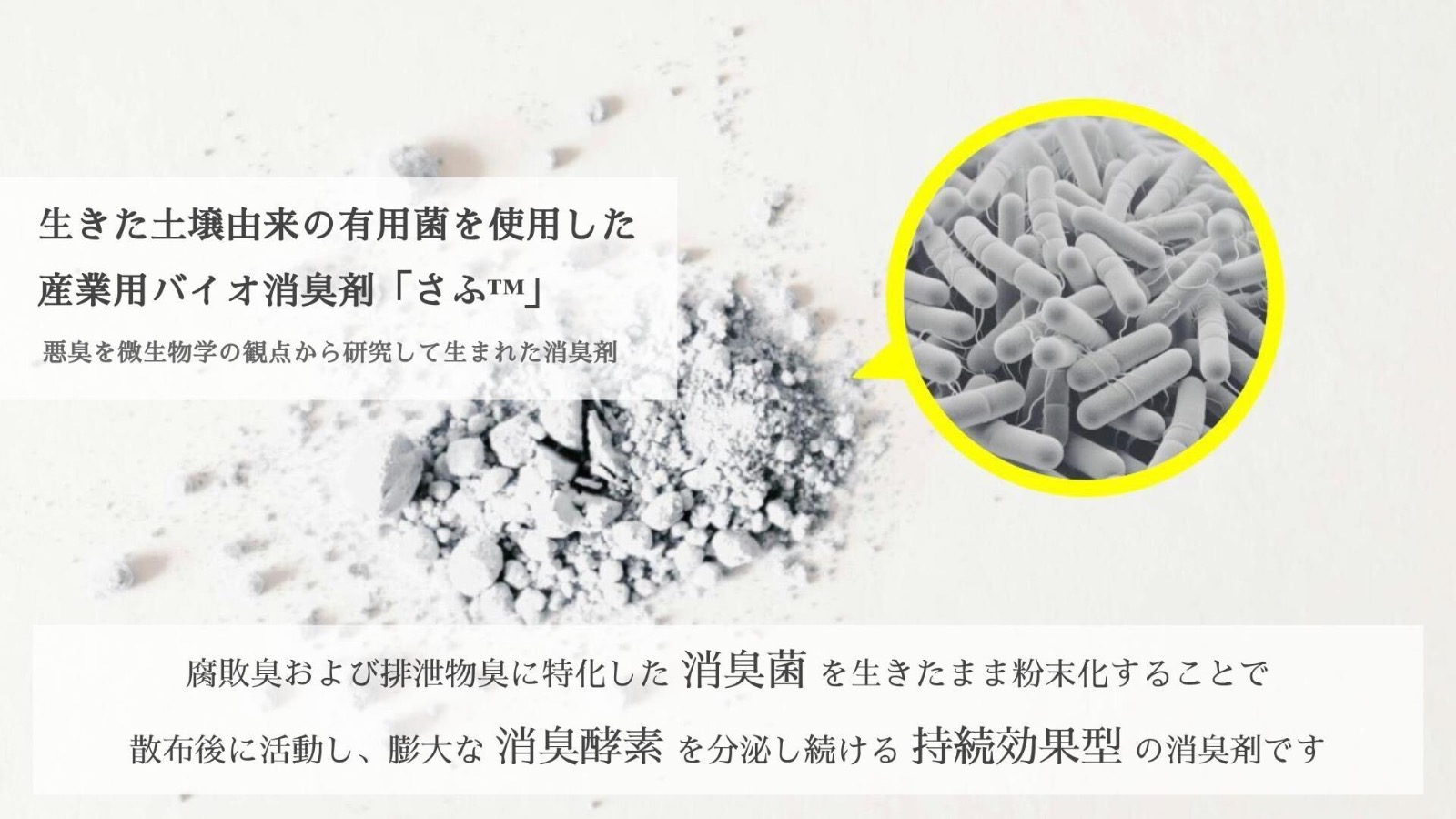
This powdered deodoriser was developed by turning live bacteria—which can neutralise odours by enzymatically breaking down malodorous compounds—into a powder. When sprinkled onto sources of odour, particularly putrid smells such as kitchen waste, sewage and excrement, the bacteria feed on the moisture and organic matter present in the target material. They then secrete large quantities of deodorising enzymes to achieve a deodorising effect.
As it consists of live bacteria, it continues to multiply whilst secreting deodorising enzymes as long as there is a supply of air, moisture and nutrients, ensuring that the deodorising effect is maintained continuously over an extremely long period.
Furthermore, as it also secretes specific insecticidal components effective against mosquitoes and fruit flies, it is an excellent product that simultaneously provides control of public health pests.
Objective
Cultivation of bacteria for use in deodorants.
- Maintain a single bacterial strain per bottle in liquid medium through serial subculturing; when manufacturing deodorants, formulate a bacterial cocktail by mixing these strains and induce spore formation within a powder mixture consisting of wheat flour and other ingredients.
- Subsequently, refine the formulation to impart functional properties and fluid characteristics suited to specific applications and scenarios, before finalising the product as a bio-deodorant. Establish this entire manufacturing workflow.
Methods
A total of five bacterial strains were purchased from NITE. Culture medium was prepared using sugar and multivitamin-mineral tablets, and liquid culture was carried out under aeration. As one bottle is used per bacterial strain, a total of five bottles’ worth of space is required; however, the bottle size may need to be adjusted depending on the available space in the incubator. If there is insufficient space in the incubator, cultivation at room temperature on a workbench may be considered, although this does not provide ideal culture conditions.