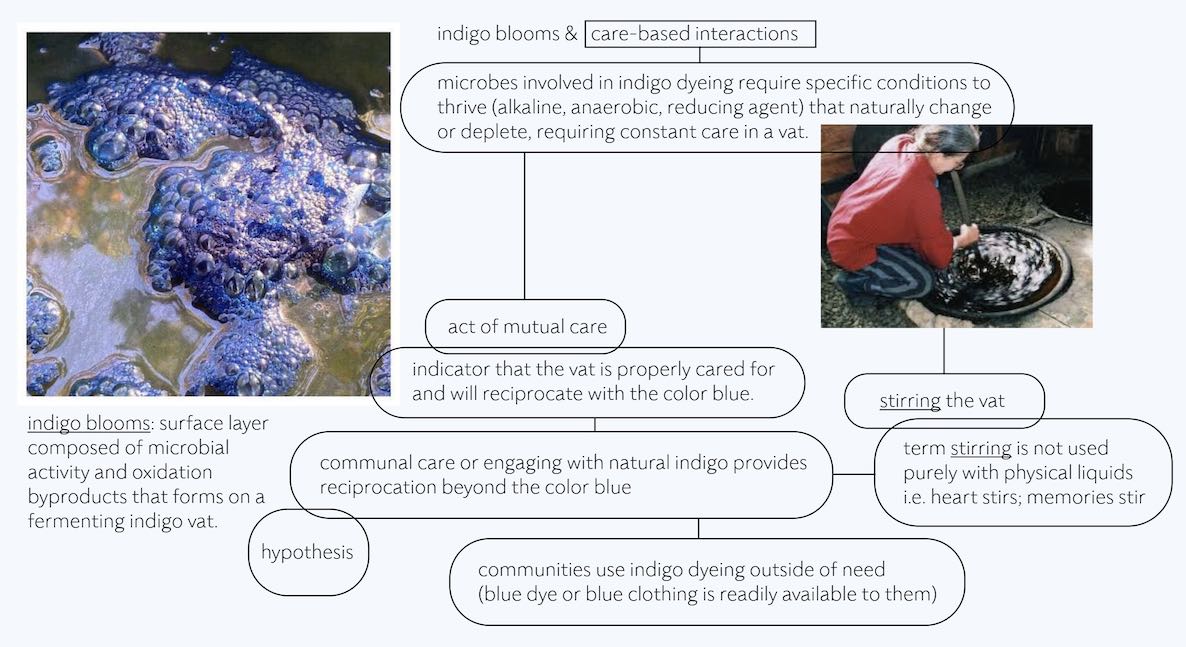
This project investigates natural indigo fermentation as a form of multispecies communication and collaborative care. In traditional dyeing methods, the indigo vat is both a chemical tool and a living system dependent on the health of specific microbial communities. These bacteria require carefully maintained conditions: high alkalinity, low oxygen, and regular sources of reducing agent, such as fructose. Because these conditions are unstable and naturally degrade over time, sustaining the vat depends on consistent, active maintenance.
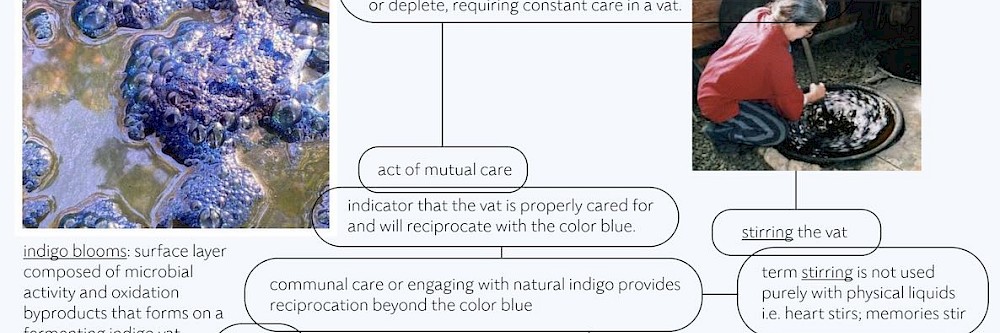
One visible marker of microbial activity in natural indigo dyeing is the surface bloom—a foamy, often iridescent film produced by bacteria. For dyers, this bloom is a diagnostic tool indicating the vat is in balance and capable of producing blue. The color blue is a form of microbial reciprocation, a material sign of care.
A key focus of the project is the act of stirring, which helps maintain the vat’s chemical and microbial balance and directly influences the distribution of the bloom. However, traditional stirring methods (from the top with a paddle) can disrupt the vat’s anaerobic conditions. To address this, the project explores using voice-generated vibrations to stir the vat from below, translating human speech into gentle, non-invasive motion. This explores how familiar human behaviors, such as speaking might be repurposed to engage with microbial systems.
The research includes both ethnographic and technical components. Interviews and observations are conducted with communities who continue indigo dyeing as a cultural practice rather than for necessity, providing insight into how care-based interactions extend beyond practical outcomes. The technical side involves sensor-based mapping of microbial bloom activity, which is then used to control actuators and inform a responsive fabrication system, speculating how ancient technologies like indigo dyeing might inform new ways of collaborating with living systems.
Objective
This study aims to deepen the understanding of human–microbial interactions and to explore how such interactions may produce mutual benefit. The specific microbial relationship examined in this research is the practice of indigo dyeing, in which microbes are nurtured within a vat and, in return, produce the color blue. This study is expected to highlight existing human-microbial relationships and interactions to show the social impact/benefits of building interspecies communities. This data will guide future prototyping, ground theoretical research on more-than-human design, and support the development of new theories and approaches to digital-hybrid crafting.
Methods
For the ethnographic studies: Conduct semi-structured interviews during shared interactions with the indigo vat (i.e. caring for the indigo vat together, dyeing with the vat together), which will be recorded with field notes, photos, audio recordings, and/or video. If time allows, I will also conduct indigo dyeing workshops with members and non-members of the BioClub Tokyo that encourage various interactions with the indigo vat. Data collection will include field notes, questionnaires, discussions, photos, and videos.
For electronic experiments: rather than using the main vat at BioClub Tokyo, I will create small auxiliary vats with experimental shapes and sensor setups. These will either use the sediment from the existing vat, or be completely new fructose vats. Signals will be monitored, recorded, and the data will be used to create various types of visual (digital and analog). Other data collection will either be user studies or autoethnography.
References
- Project Website: https://sukumo-net.github.io/sukumo/
- Similar HCI research: https://dl.acm.org/doi/10.1145/3623509.3633386